 By Kalix Poul
For the first time in human history, everyone has a camera in their pocket, all the time. While I think this is a net positive, as more people than ever are able to capture memories with friends, staggering views, and whatever they had for dinner, I still find myself frustrated when I see those grainy, de-saturated, samey-looking pictures on my Instagram feed.
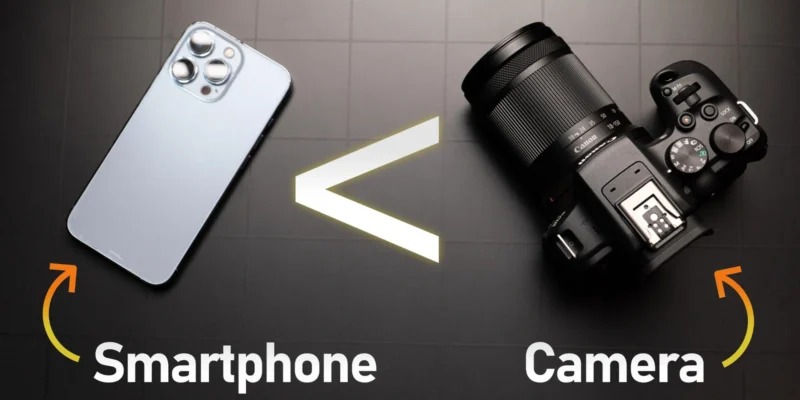
But this article isn’t about my problems with smartphones and their stale photos. No, it’s about why a real camera’s photos will always look better than a smartphone’s, no matter how many megapixels the tech giant spoonfeeds us with their latest models.
Photo Quality
Let’s get this one out of the way. The photos you capture on your phone are fine. Passable. Especially if their only purpose is as a part of an infinite digital collage that you occasionally scroll through. But if you actually want to do something with your photos, like post them online, or showcase them on one of Snapfish’s prints, then a camera is always a better choice.
Smartphone manufacturers are all obsessed with megapixels and have been for decades, as if they are the only metric that matters when it comes to quality. It’s something simple and easy that we – the stupid consumers with tiny brains – can wrap our heads around.
This is obviously a load of codswallop. And I think that us – the photo-taking public – are smarter than this. We are fully capable of understanding that a real camera has a bigger sensor that can capture more light and detail, as well as a much larger lens that produces higher quality images and is capable of maintaining that quality when it zoom in.
No Distractions; Just Taking Photos
When I made the decision to buy my first proper camera, it wasn’t actually because of the photo quality. Well, that wasn’t the main reason. It was because I wanted to use my phone less and have a dedicated tool for one of my favourite hobbies.
No notifications. No ridiculous suite of features and filters. Just a camera that takes good photos. A device which, when I take it on a walk, or on a trip abroad, I mean businesses with. I won’t just stand there, pointing it at something absent-mindedly and spamming the capture button.
I’ll look for the right angle, pay close attention to framing, focus on the right point of the subject, and shoot a couple of photos, before moving on. The camera feels solid in my hands; it’s more stable, and truly feels like a perfect, purpose-built tool that captures moments worth of my blog and photo books.
Closing Thoughts
I still understand the appeal of a smartphone camera, and even use my own occasionally. It’s convenient, and a lot of the time, its results are passable. But if you want to take better photos and have the most fun doing it, then invest in a proper camera. It doesn’t have to be the best; there are some excellent finds on the used market.